
Journal of Royal Dental College
JRDC
The Official Publication of Royal Dental College
Iron Hills, Chalissery, Palakkad Dt., Kerala 679536
www.rdcjournal.org; rdcjournal25@gmail.com
E-ISSN: 3139-8278
The Official Publication of Royal Dental College
Iron Hills, Chalissery, Palakkad Dt., Kerala 679536
www.rdcjournal.org; rdcjournal25@gmail.com
E-ISSN: 3139-8278
The Distribution and Types of Carabelli Cusp in Dental Students - An Institutional Study
Full Html
INTRODUCTION
Dental anthropology delves into the examination of morphological variations and dimensions within the dentition of human populations across different times and locations. This field aims to unravel the intricate connection between dental features, adaptation processes, dietary shifts and their role in the evolution of both the dental system and the human race.[1] An early milestone in this exploration was the documentation of the Carabelli trait in 1842 by Sir George Carabelli. The Carabelli structure manifests as a tubercle, cuspule, or groove commonly observed on the palatal surface of the mesiopalatal cusp in maxillary permanent molars and maxillary second deciduous molars.[2] A comprehensive understanding and analysis of such traits offer invaluable insights into the phylogeny of humans, distinctions among races and subraces, and the broader patterns of human biological variation.[3] Surprisingly, despite the potential richness of information embedded in various dental morphological features, such as the Carabelli trait, anthropologists have not fully harnessed their potential in studying the diversity present within the Indian population. Therefore, this study was conceived to meticulously assess the prevalence of this nonmetric dental crown feature specifically in dental students within our institution.
MATERIALS AND METHODS
A cross-sectional descriptive study was carried out in department of oral pathology and microbiology at Royal dental college. A total of 160 students ranging from age of 18-25 were clinically examined. Any individuals with severe caries, restorations or missing maxillary first molars or unilateral side were excluded. A verbal consent was solicited from the study participants prior to the oral examination. Permanent maxillary first molars were carefully examined for the Carabelli’s trait clinically from occlusal view using mouth mirror and dental explorer. Dahlberg classification system was used to score the trait on the teeth
Dahlberg’s (1963) scale for the determination degree and expression of Carabelli’s cusps
Type 0-Smooth
Type 1-Small vertical ridge and grooves diverging from depression
Type 2-Small pit with minor grooves diverging from depression
Type 3-Double vertical ridges or slight and incomplete cusp outline
Type 4-Y form moderate grooves curving in opposite directions
Type 5-Small tubercle tubercle
Type 6-Broadcusp outline, moderate Type 7-Large tubercle with free apex
When the observed teeth express the trait, it was marked and graded among 1 to 7 scores based on degree of expression. When observed teeth do not express the trait it was scored as Type 0. The teeth were examined by Two observers independently to eliminate intra-observer variation in interpretation.
RESULTS
A prospective study was conducted in our institution to assess the prevalence and patterns of cusp of Carabelli trait. The score was numerically taken by two observers and total value was expressed as percentile. Among 160 students, only 23 males (14.3%) were found. As the study group had majority of females (85.6%), the sex predilection in the Carabelli trait cannot be assessed. Cusp of Carabelli trait was expressed only in 17% (27) of the study group and majority of the cases had Type 0 (83%). (Table 1) (Chart 1)
Carabelli Trait | Number of cases |
Present | 27 |
Absent (Type 0) | 133 |
Table 1: Distribution of Carabelli trait among the study group
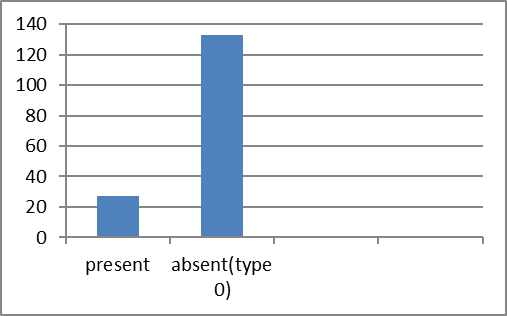
Chart 1: Bar graph showing distribution of cusp of Carabelli trait among the study group
It was found in the present study that type 0 (133 cases, 83%) was the most frequently expressed followed by Type 4 and Type 5 (5.6 %), (Figure 1)Type 6 (3.75%), (Figure 2) Type 3 (1.25%) and type 1 (0.6%) were least expressed and Type 2 and Type 7 was not expressed among the individuals. The expression of the trait was bilateral among the surveyed groups. (Table 2) (Chart 2)
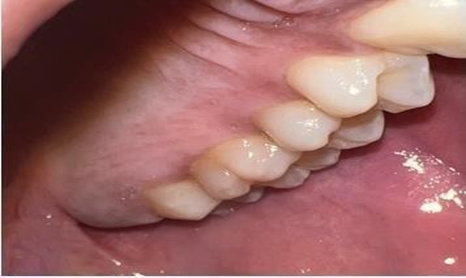
Figure 1 showing cusp of Carabelli Type 5
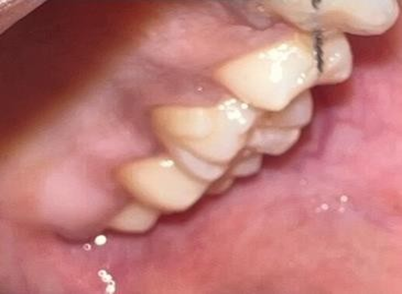
Figure 2 showing cusp of Carabelli Type 6
Types | Number of cases |
0 | 133 |
1 | 1 |
2 | 0 |
3 | 2 |
4 | 9 |
5 | 9 |
6 | 6 |
7 | 0 |
Table 2 Distribution of various types of cusps of Carabelli trait among the study group
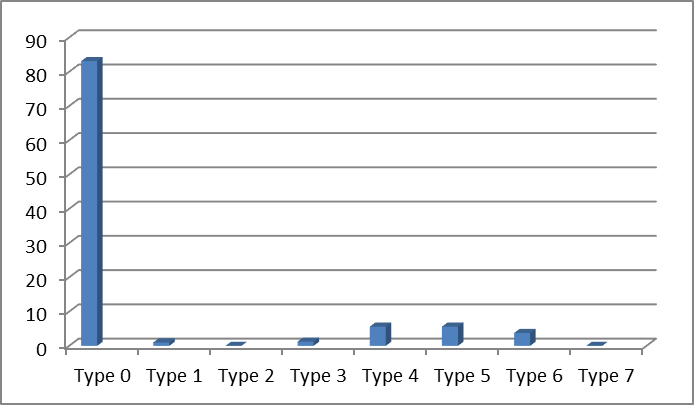
Chart 2: Bar graph showing distribution of various types of cusps of Carabelli trait among the study group
DISCUSSION
Traditionally, tooth crown morphological traits' frequency and variability have served as a basis for comparing human populations, exploring geographical distributions, and drawing inferences about migratory patterns and population affinities.[4] The cusp of Carabelli, an accessory cup involving enamel and dentine, with or without pulpal involvement, is influenced by the PAX and MS genes. This cusp signifies adaptation in the buccolingual aspect, diminishing with age. Functionally, it absorbs biomechanical stress by broadening the occlusal table, but its groove may be susceptible to caries.[5] Carabelli's trait is most prevalent among European populations, followed by African populations, while American Indians exhibit the lowest prevalence, with other Mongoloid races having even lower occurrences.
Interestingly, our study revealed an overall prevalence of 17% in the surveyed group (table 1 and graph 1). Utilizing absent. (table 2 and graph 2). The present study differs from previous recent researches by Sureshbabu S et al (52%) and Nair HR et al (48%).[6,7] However, our study has limitations; firstly, the sample size was relatively small, and a larger sample would offer a more accurate portrayal of the trait in the target population. Secondly, various ethnic groups were not considered, limiting our understanding of phenotypic expression differences. Future studies are recommended to address these limitations and enhance our comprehension of the Carabelli trait's prevalence and variations.
CONCLUSION
Cusp morphological variations are prevalent in both primary and permanent dentition. The phenotypic forms of enamel are influenced and regulated by an individual's and population's genome. Carabelli's trait presents a probabilistic model that can aid in distinguishing individuals within specific human populations, particularly for forensic purposes, considering its genetic and environmental influences.
References
